The Economic Feasibility of
a
New Luxury Hotel in
Downtown Waco
by
Tom Kelly, Ph.D.
Baylor Center for Economic
Analysis
June 1994
Introduction
Texas ranks fourth in total travel
expenditures among the 50 states, behind only California, Florida, and New
York. The 5.7 percent growth in Texas
during 1992 exceeded the 5.1 percent growth rate for the nation. Among domestic travelers, Texas also experienced
a 5.7 percent growth rate, compared with a 4.1 percent increase for the entire
nation.
Waco,
due to its geographic location on Interstate 35, is in a unique position to
benefit from a rapid growth in visitor spending in the future. However, overnight stays may be limited by
the lack of hotel space. This study
examines that possibility based upon the projected future demand for hotel
space in Waco, Texas.
The study
consists of following four phases:
Phase one determines a
baseline forecast of the demand for future hotel space in the Waco market based
upon past performance.
Phase two considers forces
that can alter this baseline forecast, including the competitive position of
Waco's lodging facilities compared with other metropolitan areas in the state
of Texas.
Phase three adjusts the
baseline forecast for projected changes in local visitor attractions, including
Big 8+ athletic events, an additional sports complex, added tourist attractions
(such as an outdoor theater), and a more competitive convention package.
Phase four compares
projected revenues with the costs involved in construction and operation of a
new hotel in order to determine if a new hotel is feasible within the
foreseeable future.
Baseline Forecast of the Demand for
Hotel Capacity in Waco
The
purpose of this phase is to determine future hotel/motel performance in the
Waco MSA based upon time series information.
This projection is a necessary step in formulating a plan for additional
hotel capacity to be located in downtown Waco.
Although past time series data can be viewed as representative of
changes in the hotel/motel market, past data will not provide information about
the possible loss of convention traffic that may have been due to the lack of
adequate hotel/motel room space.
Projections of past lodging industry performance must also be adjusted
for projected changes in local visitor attractions. For this reason, the projection of past data provides only a
baseline forecast that must be adjusted for changes in both visitor attractions
and past capacity constraints.
The Forecast Methodology
Time series data consists of four components
that may explain variation from one period to the next. These four factors can be described as trend forces that change in the long
run, business cycle forces that
change with the level of economic activity, seasonal
forces that change within the year but regularly repeat from one year to the
next, and irregular forces that
consist of outside influences that either are not expected to occur again or
can be viewed as random. In general,
trend and seasonal forces can be projected into the future more easily than
cyclical influences. Irregular
influences may be removed from past experiences to provide a better picture of
past changes, but they do not enter into future projections since they are
viewed as either random or unlikely to reoccur in the future. (An example of a irregular influence would
the be the Branch Dividian standoff, when government officials and media
crowded into Waco due to an unusual event that is unlikely to occur again in
the future.)
In
order to determine the relative importance of these four sources of change in
hotel/motel performance in the Waco market, quarterly data for lodging within
the Waco Metropolitan Statistical Area is examined for the period 1988 through
1993 using the decomposition method.
Both trend and seasonal factors are removed and the cyclical-irregular
residual is identified. Removal of past
irregular influences allows for the projection of trend values for hotel room
revenues that provides a baseline forecast of future annual hotel performance
in the Waco market. From these baseline
projection the impact of future changes in the Waco travel industry are
estimated.
Quarterly Hotel Performance
in Waco
Room revenue (the combination of occupancy
and average room rate) is the primary value used to determine changes in the
demand for hotel space in the Waco market.
Room revenue, occupancy rates, and average room prices for Waco's
lodging industry for each quarter beginning in 1988 through 1993 are shown in
Table 1. A visual inspection of the
data shows that during the first quarter of 1993 the Branch Dividian holdout
resulted in an irregular (exogenous) influence that contributed to
substantially higher hotel performance than predicted by trend, seasonal, or
cyclical influences.
Table 1: Quarterly Hotel Performance in Waco MSA
|
Yr/Qtr |
Nights |
Room |
% OCC* |
$ Rate** |
|
|
Sold |
Revenue |
(nts sold/ |
(avg price |
|
|
(thous.) |
($thous) |
nts avail) |
per nt sold) |
|
|
|
|
|
|
|
88/1 |
91.5 |
$3,313 |
43.5 |
$36.22 |
|
88/2 |
100.7 |
3,842 |
47.3 |
38.16 |
|
88/3 |
108.3 |
4,061 |
49.4 |
37.50 |
|
88/4 |
99.5 |
3,610 |
45.1 |
36.29 |
|
89/1 |
93.4 |
3,341 |
44.2 |
35.77 |
|
89/2 |
106.4 |
3,935 |
50.2 |
36.99 |
|
89/3 |
113.3 |
4,223 |
52.1 |
37.26 |
|
89/4 |
106.3 |
3,770 |
49.6 |
35.47 |
|
90/1 |
98.7 |
3,563 |
47.7 |
36.11 |
|
90/2 |
103.9 |
3,896 |
49.7 |
37.50 |
|
90/3 |
110.3 |
4,072 |
47.6 |
36.90 |
|
90/4 |
96.9 |
3,533 |
46.4 |
36.47 |
|
91/1 |
95.0 |
3,617 |
44.8 |
38.07 |
|
91/2 |
110.4 |
4,343 |
50.4 |
39.33 |
|
91/3 |
118.1 |
4,317 |
53.4 |
36.54 |
|
91/4 |
108.2 |
3,958 |
49.6 |
36.59 |
|
92/1 |
100.8 |
3,784 |
47.2 |
37.53 |
|
92/2 |
113.5 |
4,574 |
51.3 |
40.31 |
|
92/3 |
120.6 |
4,530 |
54.9 |
37.56 |
|
92/4 |
109.6 |
4,132 |
51.5 |
37.72 |
|
93/1 |
114.7 |
4,616 |
52.5 |
40.25 |
|
93/2 |
121.0 |
5,180 |
53.9 |
42.65 |
|
93/3 |
130.0 |
5,033 |
56.6 |
38.86 |
|
93/4 |
116.0 |
4,474 |
55.2 |
38.67 |
* Occupancy rate is nights sold divided by nights available for sale (x 100). ** Rate is the average price for each roomnight sold. Source: Texas Department of Commerce from Market Share/Source Strategies, Inc.
Table
1 also shows that the upward trend in room revenue in the Waco market is more a
function of higher occupancy rates than an increase in average room
prices. (One of the questions that will
be addressed is the question of the relationship between occupancy rates and
room prices and whether or not Waco can support a hotel with higher
"luxury" prices.) In general,
higher average room prices also accompany higher occupancy rates. Hence, room revenue is more representative
of market demand than either occupancy rates or room prices and, therefore,
will be the primary measure of hotel performance projected into the future.
Decomposition of Hotel
Performance
Forces
explaining changes in hotel performance consist of trend factors, such as
demographic forces that affect tourism; seasonal factors, such as the weather,
normal vacation periods, or Baylor University events that repeat within each
year; cyclical factors, such as business performance that affects convention
traffic; and irregular forces, such as the Branch Dividian holdout that are unusual
events that are unlikely to occur again in the future. A starting point in time series forecasting
is the application of the decomposition method to past time series data in
order to determine the relative importance of each of these four sources of
variation.
The
long run secular trend may be estimated with a least-squares regression line,
either in linear or non-linear form.
Seasonal changes are eliminated using seasonal indexes derived by the
ratio-to-moving-average method.
Seasonal factors are reported that coincide with the Census X-11 program
for time series decomposition. The
combined R-squared of a model using trend and seasonal factors measures the
percentage of past variation in hotel performance explained by these two
influences. The remainder of one
hundred percent is due to cyclical or irregular influences. This residual may be expressed as an index
by dividing the observed value by the forecast value based upon trend and
seasonal influences and multiplying by 100.
The resulting cyclical-irregular relative will exceed 100 when actual
performance exceeds the amount predicted by trend and seasonal factors and will
be less than 100 when actual performance falls below the predicted value. To the extent that trend and seasonal forces
are most important (high R-squared), future projections are more accurate than
if business cycle conditions or irregular influences dominate. Cyclical influences are difficult to project
very far into the future, and irregular influences cannot be predicted, since
they are viewed as unusual events that may or may not occur again in the
future.
Seasonal
indexes for quarterly hotel revenues, occupancy rates, and average price per
room were calculated for the period 1988 through 1992. (The year 1993 was not used because of the
unusual performance during the first quarter as a result of the Branch Dividian
holdout.) The results, shown in Table
2, indicate significantly greater seasonal variation in hotel revenues than in
occupancy rates. Average room prices
fluctuate even less from quarter to quarter due to seasonal influences. (Seasonal indexes average 100 for the year,
exceed 100 when seasonal forces are favorable, and fall below 100 when seasonal
forces are unfavorable.)
Table 2: Seasonal Indexes for Measures of Hotel
Performance
|
Quarter |
Room Revenue |
Occupancy Rate |
Average Room
Rate |
|
|
|
|
|
|
I |
91.5 |
94.2 |
99.5 |
|
II |
105.1 |
102.9 |
103.0 |
|
III |
108.0 |
104.1 |
100.0 |
|
IV |
95.4 |
98.7 |
97.5 |
Source: Computed from Quarterly Data from Texas Department of Commerce, Tourist Division
Trend - Seasonal Forecast of
Hotel Revenue
A least squares regression model that assumes
a nonlinear trend with a constant growth rate and a seasonal factor for each
quarter, based upon the ratio-to-moving-average, explained 83.3 percent of the
variation in quarterly hotel room revenue in the Waco Metro Area over the
period from 1988 through 1993. (A
nonlinear trend-seasonal model slightly outperformed a linear trend-seasonal
equation that explained 82.9 percent of the variation in room revenue.)
Table 3: Sources of Variation in Quarterly Hotel Room
Revenues
|
Year.Qtr |
Room |
Revenue |
Cyclical- |
Year.Qtr |
Room |
Revenue |
Cyclical- |
|
|
Actual Value |
Trend-seasonal |
Irregular Relative |
(cont.) |
Actual Value |
Trend-seasonal |
Irregular Relative |
|
|
($thous) |
Forecast |
(percent) |
|
($thous) |
Forecast |
(percent) |
|
|
|
|
|
|
|
|
|
|
88.1 |
$3,313 |
$3,319 |
99.8 |
91.1 |
3,617 |
3,752 |
96.4 |
|
88.2 |
3,842 |
3,753 |
102.4 |
91.2 |
4,343 |
4,242 |
102.4 |
|
88.3 |
4,061 |
3,847 |
105.6 |
91.3 |
4,317 |
4,392 |
98.3 |
|
88.4 |
3,610 |
3,534 |
102.2 |
91.4 |
3,958 |
3,994 |
99.1 |
|
89.1 |
3,341 |
3,458 |
96.6 |
92.1 |
3,784 |
3,908 |
96.8 |
|
89.2 |
3,935 |
3,909 |
100.7 |
92.2 |
4,574 |
4,419 |
103.5 |
|
89.3 |
4,223 |
4,047 |
104.3 |
92.3 |
4,530 |
4,575 |
99.0 |
|
89.4 |
3,770 |
3,681 |
102.4 |
92.4 |
4,132 |
4,161 |
99.3 |
|
90.1 |
3,563 |
3,602 |
98.9 |
93.1 |
4,616 |
4,071 |
113.4 |
|
90.2 |
3,896 |
4,072 |
95.7 |
93.2 |
4,574 |
4,603 |
99.4 |
|
90.3 |
4,072 |
4,216 |
96.6 |
93.3 |
4,530 |
4,766 |
95.0 |
|
90.4 |
3,533 |
3,834 |
92.1 |
93.4 |
4,474 |
4,334 |
103.2 |
Source: Computed
from quarterly data supplied by Texas Department of Commerce
Table 3 shows the actual values, the
trend-seasonal forecast, and the cyclical-irregular relatives for each
quarter. The least squares regression
results indicate that hotel room revenues increased an average of 1.02 percent
each quarter from 1988 through 1993 due to trend factors, holding the effect of
seasonal changes constant. The mean
absolute percentage error of the trend-seasonal forecasting model was 3.1
percent.
The
cyclical-irregular relative, shown for each quarter in Table 3, provides a
measure of the expected accuracy of quarterly forecasts based solely upon trend
and seasonal forces. If actual room
revenue equaled the amount predicted by trend and seasonal forces, the
cyclical-irregular relative equal 100.
The cyclical-irregular relatives show than in only three quarters were
predicted values based upon trend and seasonal factors more than five percent
different than actual values. Room
revenue in the third quarter of 1988 was 5.6 percent more than predicted. In the fourth quarter of 1990, actual hotel
room revenue was 7.9 percent below the amount predicted by trend and seasonal
forces. In the first quarter of 1993,
actual hotel room revenue exceeded the amount predicted by trend and seasonal
forces by 13.4 percent.
The
year 1990 was the beginning of a cyclical downturn that resulted in less travel
for both business and tourist purposes.
The largest impact of the business cycle on hotel revenue occurred
during the fourth quarter of 1990.
Since that time, the cyclical component of travel demand has generally
improved. The unusual increase in hotel
room revenue that occurred during the first quarter of 1993 was due to the
Branch Dividian holdout that brought worldwide media attention and visitors to
Waco. Without major irregular
influences and reasonably steady business cycle conditions a quarterly forecast
of hotel revenue based upon trend and seasonal forces would result in no more
than 5 percent error from actual values.
Long Term Trend Projections
Annual
data does not exhibit seasonal variation that occurs within the year. Annual data also allows for averaging of
irregularities that occur from quarter to quarter but offset each other
throughout the year. The residual from
trend changes does reflect the influence of cyclical influences and major
irregular events that are not offset during other periods of the year. Hence, these irregular influences need to be
removed from past observations in order to reflect more accurately trend and
cyclical influences.
In
order to determine a trend projection for Waco's hotel revenue, annual data was
examined over the period 1988 through 1993.
However, the major irregularity that occurred during the first quarter
of 1993 (the Branch Dividian holdout) was not considered in making future
projections. In order to remove this
influence, annual data in 1993 was adjusted to reflect the forecast value for
the first quarter of 1993 (shown in Table 3) rather than actual hotel
revenue. The amount of actual hotel
revenue during the first quarter of 1993 amounted to $4,616 thousand, while the
projected value based upon past trend and seasonal forces amounted to $4,071
thousand. The increase in 1993 hotel
revenue by an estimated $545 thousand due to the Branch Dividian holdout is
removed when determining the baseline forecast of annual hotel revenue based
upon a trend projection.
A non
linear model that assumed an average growth rate was the preferred model to
project the annual trend value in hotel room revenue. (A average growth rate model explained 93.4 percent of the
variation in hotel revenue from 1988 through 1993 as opposed to a linear,
average change model that explained 92.6 percent of the variation.) The projected trend and calculated
cyclical-irregular relatives for the years 1988 through 1993 are given in Table
4.
Table 4: Annual Hotel Room Revenue, Projected Trend
Values, and
Cyclical-Irregular Relative*
|
Year |
Hotel Revenue |
Trend |
Cyclical-Irregular
|
|
|
|
Forecast |
Relative |
|
|
|
|
|
|
1988 |
$14,826 |
$14,407 |
102.9 |
|
1989 |
15,268 |
15,081 |
101.2 |
|
1990 |
15,063 |
15,787 |
95.4 |
|
1991 |
16,235 |
16,526 |
98.2 |
|
1992 |
17,020 |
17,300 |
98.4 |
|
1993 1994 1995 1996 1997 1998 1999 2000 |
19,395 |
18,110 18,958 19,845 20,775 21,747 22,765 23,831 24,947 |
107.1 |
Source: Computed from Data by Texas Department of Commerce, Tourist Division. *CI relative is computed by dividing actual revenue by its trend and multiplying by 100.
An examination of the
cyclical-irregular relative shows that for the year 1988 Waco hotel revenue
exceeded its trend value by 2.9 percent.
Business cycle conditions in 1990 resulted in a substantial decline in
hotel revenue, reaching 4.6 percent below its trend level. The business cycle recovery and the
development of additional visitor attractions improved Waco hotel performance
over the past three years. However, the
cyclical-irregular relative in 1993 of 107.1 reflects not only improvement in
the economy and more visitor attractions, but it also reflects the Branch
Dividian irregularity that is included in actual hotel revenue but not in the
trend estimate. The elimination of $545
thousand in 1993 hotel revenue attributed to the Branch Dividian holdout
reduces the cycle-irregular component to 104.1, or 4.1 percent above the
estimated trend.
During
the years 1988 through 1993 (adjusted for the Branch Dividian holdout), Hotel
room revenue in Waco experienced an average increase of 4.6 percent each
year. When trend forces are used to
project future hotel room revenue, almost $25 billion in annual hotel room
revenue is projected to occur in the Waco lodging market by the year 2000.
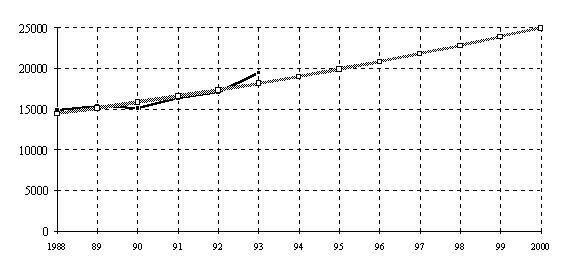
Figure 1: Projected Trend in Hotel Revenues in Waco, Texas
Through the Year 2000
Source: Calculated for data supplied by Texas Department of Commerce, Tourist Division
Figure 1 shows the projected
trend in hotel room revenues through the year 2000 based upon recent
performance. This baseline annual
forecast was generally too high during for the three year period beginning in
1990, primarily because of the slow recovery from the 1990-91 economic
recession. However, hotel revenue
performance during 1993 was well above the predicted trend, even after the
Branch Dividian adjustment. In all
likelihood the trend projection to the year 2000 is conservative, provided the
economy continues to perform reasonably well and Waco continues to develop its
tourist attractions and convention activity.
The
trend in hotel revenues is a reflection of both an increase in average
occupancy rates and an increase in the average price for each roomnight
sold. Annual totals for each of these
measures from 1988 through 1993, in addition to the average number of hotel
rooms available and the number of nights sold, in the Waco metropolitan area
are presented in Table 5.
Table 5: Annual Hotel Performance in Waco
Metropolitan Area
|
Year |
Nights Sold |
Room Revenue |
Occupancy |
Average |
|
|
(thousands) |
($ thousands) |
Rate (%)* |
Price/room
($)** |
|
|
|
|
|
|
|
1988 |
400 |
$14,826 |
46.4 |
$37.07 |
|
1989 |
419 |
15,268 |
49.0 |
36.40 |
|
1990 |
410 |
15,063 |
47.8 |
36.76 |
|
1991 |
432 |
16,235 |
49.6 |
37.60 |
|
1992 |
454 |
17,020 |
51.2 |
38.29 |
|
1993 |
484 |
19,395 |
56.8 |
40.07 |
* Occupancy rate is nights sold divided by nights available for sale (x 100). ** Rate is the average price for each roomnight sold. Source: Texas Department of Commerce from Market Share/Source Strategies, Inc.
While
the annual growth rate in room revenue from 1988 through 1993 averaged 4.6
percent, the number of nights sold grew at an average annual rate of 3.2
percent, the occupancy rate increased an average of 3.4 percent annually, and
the average room price increased 1.3 percent annually. During the same five year period the number
of hotel rooms in the Waco market remained virtually unchanged (2,362 rooms in
1988 to 2,372 rooms in 1993).
Competitive Factors Affecting Hotel Performance
The
success of a new "luxury" hotel in Waco of about 200 rooms (the
Hilton Hotel has 196 rooms) will depend upon continued growth in the total
lodging market as well as the competitive position of a new hotel among
existing hotels in the market. Waco's
lodging industry is experiencing both higher occupancy rates and higher average
room prices. Table 6 shows that a
positive correlation between occupancy rates and average room rates exists not
only over time but also among a cross section of hotels in Waco and in the
state of Texas. This suggests that,
within limits, hotel rooms are a luxury good.
Table 6 also shows that Waco has higher occupancy rates than the state
average for all but the lowest priced rooms offered by hotel chains. However, Waco suffers from the absence of
higher priced luxury rooms that add substantially to hotel revenues in major
metropolitan areas. In Waco, the
highest prices rooms have an average nightly rate of about one-half the average
rate of the highest priced rooms in the state.
Table 6: Occupancy Rate and Average Price per Day of
Hotel Rooms, 1993
|
|
Waco |
Chains |
State of Texas
Chains |
|
|
Price Range |
Occupancy % |
Rate $ |
Occupancy % |
Rate $ |
|
|
|
|
|
|
|
$00-29.99 |
55.3 |
26.73 |
54.4 |
$26.52 |
|
$30-39.99 |
54.4 |
34.74 |
56.9 |
35.09 |
|
$40-49.99 |
66.2 |
45.97 |
61.9 |
45.21 |
|
$50-50.99 |
68.9 |
53.12 |
64.9 |
54.74 |
|
$60-60.99 |
73.4 |
63.83 |
67.8 |
65.10 |
|
$70-79.99 |
a |
a |
69.0 |
75.10 |
|
$80-89.99 |
a |
a |
71.0 |
84.37 |
|
$90-99.99 |
a |
a |
70.8 |
93.80 |
|
$100-109.99 |
a |
a |
71.3 |
103.67 |
|
$110+ |
a |
a |
72.6 |
126.24 |
|
a: none reported |
Source: Texas Department of Commerce, Tourist
Division |
|||
The
demand for luxury hotel space is derived from an area's relative attractiveness
as a tourist and business destination.
This, in turn, is largely a function of area income and population
density. There are some relatively
isolated tourist attractions that support luxury accommodations, but they are
generally accompanied by a unique, immovable resource, such as beach
frontage. Waco is rapidly developing a
tourism package that can attract overnight visitors. It also has an advantage with its central location for regional
conventions that are attended primarily by automobile travelers. However, in order to move to the next level
of room rates, it must develop accommodations that offer an advantage over
existing facilities. A new facility
could charge marginally higher room rates and, at the same time, experience
above average occupancy rates. To the
extent that existing hotels did not modernize, there would be a room
"filtering" effect that could lower the demand for lower priced,
older facilities in Waco, and result in a shift in the market in favor of a new
hotel.
Table
7 shows that most of the state's metro areas offer higher priced rooms than
Waco. It also shows that among these
metro areas the higher priced rooms often experience occupancy rates well above
the average occupancy rate for the area.
However, the highest priced "luxury' rooms selling above $124 per
night occur only in Dallas, Houston, San Antonio, and Austin.
Table 7: Prices Per Room and Percent Occupancy Among
Texas Metro Areas
|
Metro Area |
Price with |
Occupancy |
Highest |
Occupancy |
Average |
|
|
Highest |
Rate at |
Price/day |
Rate of |
Occupancy |
|
|
Occupancy |
This Price |
|
Highest Price |
Rate |
|
|
|
|
|
|
|
|
Abilene |
$67.98 |
76.5% |
$73.76 |
70.7% |
52.9 |
|
Amarillo |
44.45 |
67.5 |
61.07 |
62.5 |
55.3 |
|
Austin |
92.89 |
73.1 |
137.58 |
65.1 |
64.3 |
|
Beaumont/Pt Arthur |
64.56 |
61.9 |
70.91 |
51.4 |
47.8 |
|
Brownsv/Harlinton |
113.22 |
79.9 |
113.22 |
79.9 |
48.2 |
|
Bryan/Col Station |
63.32 |
66.2 |
63.32 |
66.2 |
58.2 |
|
Corpus Christi |
119.64 |
70.9 |
119.64 |
70.9 |
48.9 |
|
Dallas |
84.64 |
72.3 |
135.98 |
72.3 |
61.7 |
|
Ft Worth/Arlington |
92.83 |
72.3 |
92.83 |
72.3 |
57.3 |
|
El Paso |
87.76 |
78.8 |
92.18 |
70.2 |
61.4 |
|
Houston |
84.22 |
70.9 |
125.81 |
65.9 |
60.6 |
|
Galveston |
104.01 |
63.5 |
104.01 |
63.5 |
47.7 |
|
Brazoria |
82.71 |
52.7 |
82.71 |
52.7 |
53.4 |
|
Laredo |
52.82 |
85.0 |
74.59 |
77.4 |
68.8 |
|
Killeen/Temple |
67.73 |
63.4 |
82.82 |
59.2 |
54.2 |
|
Longview/Marshall |
53.53 |
59.4 |
53.53 |
59.4 |
51.5 |
|
Lubbock |
102.36 |
94.1 |
102.36 |
94.1 |
57.1 |
|
McAllen/Edinburg |
101.26 |
78.6 |
101.26 |
78.6 |
60.9 |
|
Odessa/Midland |
61.38 |
57.7 |
61.38 |
57.7 |
41.3 |
|
San Angelo |
58.16 |
65.2 |
58.16 |
65.2 |
51.6 |
|
San Antonio |
104.43 |
79.1 |
124.07 |
73.8 |
68.7 |
|
Sherman/Dennison |
51.39 |
55.7 |
123.64 |
35.7 |
44.4 |
|
Texarkana(TX) |
42.53 |
58.3 |
54.56 |
53.8 |
39.0 |
|
Tyler |
62.66 |
66.4 |
80.42 |
71.4 |
53.2 |
|
Victoria |
43.71 |
62.0 |
50.48 |
59.3 |
54.5 |
|
WACO |
63.83 |
73.4 |
63.83 |
73.4 |
56.8 |
|
Wichita Falls |
55.28 |
66.5 |
55.28 |
66.5 |
54.3 |
Source: Texas Department of Commerce, Tourist Division
Waco's
average occupancy rate of 56.8 percent in 1993 was very close to the state
average of 57.7 percent. Partly because
of the Branch Dividian holdout, but also because of the growth in tourist
attractions, Waco was the fourth fastest growing market in the state in
1993. Room revenue increased 13.3
percent compared with the state average of 5.9 percent. When 1993 room revenue is adjusted for the
Branch Dividian holdout the 1992-93 percentage increase amounts to 9.6 percent,
still well above the state average.
With the Branch Dividian adjustment it drops to the fifth fastest
growing market, slightly below Texarkana. .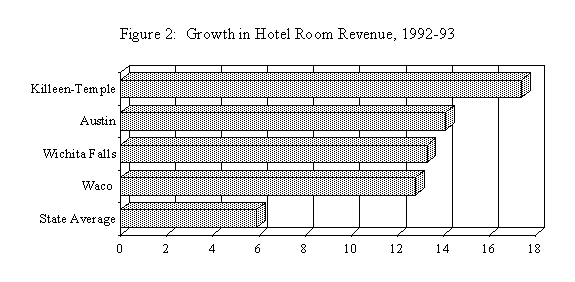
Source: Texas Department of Commerce, Tourist Division
Figure
2 shows the state metro areas that experienced the fasted growth in room
revenue in 1993 from the previous year.
Killeen has been experiencing a housing shortage due to the relocation
of troops to Fort Hood, and hotel occupancy has helped to provide temporary
housing. Geographically, the four
central, contiguous metros of San Antonio, Austin, Waco and Killeen grew 13.5 %
in the year and accounted for over one-half of the state's total lodging gains,
double their historic importance in the market.
Additional Forces Affecting Waco's Lodging Market
Although
the average rate of trend growth for hotel room revenue is 4.6 percent, there
is reason to expect that future projections based upon past averages are
conservative. The most recent increase
in hotel revenue, after adjustment for the Branch Dividian holdout, was over
double the historical average. Waco has
made great strides in developing its tourism industry. The Sport's Hall of Fame, the Cameron Park
Zoo, the Dr. Pepper Museum, to name a few, are attractions that have been added
to the traditional menu that includes Fort Fisher and the Armstrong Browning
Library. Attendance at local tourist
attractions increased by 7.3 percent in 1993 compared with the previous year.
In
the next several years Baylor University is expected in add significantly to
its already important impact on the number of visitors into the area. Big 12 sporting events are likely to have a
major impact. The Baylor Athletic
Department is projecting 10,000 additional visitors for each Big 12 football game
in Waco. These events are likely to
result in similar effects on Waco's lodging market as Baylor Homecoming has had
in the past, namely 100 percent occupancy rates, especially for the higher
priced segment of the market.
Waco
is already a central location for many statewide sporting events, such as the
state Little League playoffs. Statewide
softball tournaments are expected to have an increased importance as Waco
expands its recreational facilities.
Improvement
in business conditions and active recruiting of convention visitors is expected
to add to the number of potential visitors in the future. There have been times in the past when
conventions have been forced to locate in other metro areas, such as Arlington,
because of a lack of hotel room capacity.
Convention hotels around the state are another reason for the highest
growth rate in occupancy among higher priced segments of the market.
Although
it is impossible to determine exactly what the impact of all of these changes
will have on Waco's future hotel market, one would be safe to say that if all
of these forces had been intact in 1990, Waco's lodging industry would have
grown at least as fast as the state average.
This constant market share growth rate would have averaged 6.5
percent.
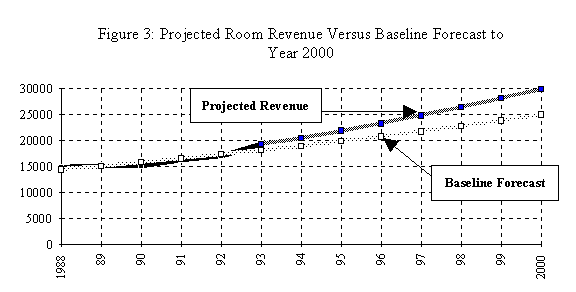
Applying
a constant market share growth projection to the baseline projection of hotel
revenue results in a forecast for area room revenue to the year 2000 of almost
$30 million, or $5 million more that the baseline projection. (See Figure 3.)
A
constant market share projection is a conservative forecast of future hotel
room revenue in the Waco market for two reasons. First, the Interstate 35 corridor is growing much faster than the
state average. In 1993, state room
revenues increased 5.9 percent while room revenues increased 13.5 percent
within the San Antonio, Austin, Killeen-Temple, and Waco contiguous areas. Second, additional attractions and
facilities are expected to improve Waco's competitive position for tourist and
convention travelers.
Source: Projected from Texas Department of Commerce data.
Economic Feasibility of a 200 Room "Luxury" Hotel
The
long-standing trend of all growth occurring at higher prices in the Texas
market continued in 1993. In 1993,
there is no gain in the total room revenues of hotels in the state priced under
$60, while revenue gains from rooms priced over $60 amounted to 11.7%. The significance of this relationship is
that even though area hotel room revenue may experience an average annual
growth of 6.5 percent, a new "luxury" hotel is expected to grow
faster than the average. Older, lower
priced motels could experience little, if any, room revenue growth with most of
the increase in room revenues received by newer, higher priced segments of the
market.
Table
8 shows the number of rooms, percent occupancy, and average room rate for all
hotels/motels for the period 1988 through the first quarter of 1993 for the
Waco Metropolitan Statistical Area and for the Hilton Hotel, the hotel at the
highest priced end of the market The
average occupancy rate for the Hilton Hotel over the period presented is 67
percent, compared with 49 percent for the all hotel/motels in the area. This higher occupancy occurred despite room
prices that averaged over $15 per night higher. From the first quarter of 1988 to the first quarter of 1993, the
average annual increase in occupancy rates was 11.1 percent for the Hilton
Hotel, compared to 3.8 percent for all area hotels/motels (including the Hilton). Average room prices, over the same period,
increased at an average annual rate of 6.2 percent for the Hilton, compared to
2.1 percent for all area hotels/motels.
The increase in room prices for all hotels/motels combined failed to
keep pace with the overall inflation rate in Central Texas that averaged 3.5
percent yearly over the same period.
Clearly a hotel in the upper price range of the market will outperform
other, lower-priced hotels/motels in Waco, as in the state of Texas.
Table 8: Occupancy Rate and Average Room Price of All
Area Hotels/Motels
Compared with the Hilton
Hotel, Quarterly from 1988.1 to 1993.1
|
Year. |
Waco
Metropolitan Area |
Hilton
Hotel |
|
|||
|
Quarter |
Rooms |
% Occ |
$ Rate |
Rooms |
% Occ* |
$ Rate |
|
|
|
|
|
|
|
|
|
88.1 |
2,337 |
43.5 |
36.22 |
196 |
46 |
46.63 |
|
88.2 |
2,337 |
47.3 |
38.16 |
196 |
56 |
49.13 |
|
88.3 |
2,381 |
49.4 |
37.50 |
196 |
54 |
49.65 |
|
88.4 |
2,395 |
45.1 |
36.29 |
196 |
57 |
49.65 |
|
89.1 |
2,349 |
44.2 |
35.77 |
196 |
59 |
49.72 |
|
89.2 |
2,330 |
50.2 |
36.99 |
196 |
64 |
50.93 |
|
89.3 |
2,363 |
52.1 |
37.26 |
196 |
67 |
52.55 |
|
89.4 |
2,330 |
49.6 |
35.47 |
196 |
61 |
49.95 |
|
90.1 |
2,300 |
47.7 |
36.11 |
196 |
72 |
49.52 |
|
90.2 |
2,295 |
49.7 |
37.50 |
196 |
68 |
52.73 |
|
90.3 |
2,522 |
47.6 |
36.90 |
196 |
75 |
50.09 |
|
90.4 |
2,267 |
46.4 |
36.47 |
196 |
70 |
49.94 |
|
91.1 |
2,357 |
44.8 |
38.07 |
196 |
72 |
54.26 |
|
91.2 |
2,407 |
50.4 |
39.33 |
196 |
73 |
58.28 |
|
91.3 |
2,406 |
53.4 |
36.54 |
196 |
79 |
49.08 |
|
91.4 |
2,370 |
49.6 |
36.59 |
196 |
75 |
52.00 |
|
92.1 |
2,375 |
47.2 |
37.53 |
196 |
69 |
54.98 |
|
92.2 |
2,431 |
51.3 |
40.31 |
196 |
66 |
60.78 |
|
92.3 |
2,386 |
54.9 |
37.56 |
196 |
66 |
57.48 |
|
92.4 |
2,313 |
51.5 |
37.72 |
196 |
72 |
57.57 |
|
93.1 |
2,426 |
52.5 |
40.25 |
196 |
78 |
62.88 |
|
Average |
2,366 |
49.0 |
37.36 |
196 |
67 |
52.75 |
|
*Occupancy is estimated
roomnights sold divided by rooms available |
|
|||||
Projected Room
Revenue
Gross room revenue (derived from taxable
revenue times an adjustment factor) for the Hilton Hotel for the period above
is shown in Table 9, along with an accompanying graph. A new, luxury hotel, is expected to
experience similar occupancy rates and could support slightly higher room rates
than the Hilton.
It
is possible to examine the feasibility of a new hotel from two perspectives. First, the market can be examined to
determine at what time in the future projected room revenue in the Waco Metro
Area would be sufficient to absorb the added room capacity of a new hotel
without causing "undue harm" on existing establishments by reducing
their existing revenues. Second, based
upon projected construction cost of a new hotel versus projected revenue, the
economic viability of the hotel can be examined in terms of its investment
return compared with industry averages.
|
|
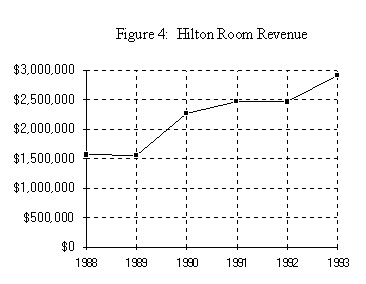
Table 9:
Hilton Hotel
Annual Room Revenue
|
Year |
Room |
|
|
Revenue |
|
|
|
|
1988 |
$1,566,254 |
|
1989 |
1,561,311 |
|
1990 |
2,265,395 |
|
1991 |
2,476,341 |
|
1992 1993 |
2,467,836 2,914,732 |
Source:
MarketShare Source Strategies, Inc.
The
Hilton Hotel has experienced a substantial increase in room revenue over the
past several years, despite sluggish economic conditions that adversely
affected area hotel room revenue during the early nineties. However, without an increase in room prices
its future room revenue has, in effect, reached a capacity limit. Hotels attempt to manage their capacity by
offering special rate packages during off peak periods of the week or year,
especially the weekend when business travelers are less frequent or during
months when vacationers are less likely to travel. Because of normal seasonal changes in demand, however, it is very
difficult for a hotel to achieve, even through the best of management and
marketing skills, an average occupancy rate in excess of 70 percent. In 1993, the highest priced segment of the
Waco hotel market (the Hilton Hotel) operated at 73.4 percent capacity with an
average room price of $63.83 per day (see Table 7).
A
new hotel of similar size and location as the Hilton can be expected to benefit
from the luxury end of the market that is currently being served by the Hilton
Hotel. Moreover, by the time a new
hotel could be constructed, say in the middle of 1996, there is reason to
believe that it could charge higher room prices. The highest priced room in Tyler averages $80.42 per day, in
Abilene $73,76 per day, and in Killeen-Temple $82.82 per day. (See Table 7). The average of these three prices of $79 per day is a reasonable
scenario for a new "luxury" hotel in Waco at the beginning of its operations. At this price, a new 200 room hotel that
experiences a 56.8 percent occupancy rate (the present market average) would
generate $3.275 million in revenue.
Based
upon the projected increase in area hotel room revenue presented in Figure 3,
total growth in the area's lodging market would support this increase without a
reduction in total room revenue received by existing hotels by the spring of
1998. Hence, by that time enough market
demand would exist to absorb the projected room revenue of a new hotel without
causing "undue harm" to existing hotels/motels in the area.
The
ability of a new hotel to generate revenue in the market would, of course,
depend upon its management and marketing skills. However, if the total market increased at only 6.5 percent each
year (the constant state market share pace) and the new hotel increased its
annual revenue at the same pace, there would be sufficient demand by the middle
of the year 2000 to support a 73 percent occupancy rate in the new hotel at a
average price of $79 per day. Of
course, if room rates increase during this period, the same revenue projections
can occur with lower occupancy rates.
Room
revenue projections for the new hotel and the projected market share of the
Waco lodging market for the first five years of the hotel are shown in Table 10
based upon an annual increase of 6.5 percent each year. Although the share of existing hotels will
fall initially when the new hotel enters the market, the same growth rate
results in a decreasing market share for the new hotel in the future. Based upon the experience of the Hilton
Hotel, these revenue projections based upon total market growth are
conservative.
Table 10: Projected Room Revenue, for Waco Market
Area, and
Percent Market Share of a
New Hotel
|
Year |
Room Revenue |
Waco Market |
Market Share |
|
|
|
|
|
|
1996 |
$3,275,000 |
$23,298,000 |
14.06 |
|
1997 |
3,448,000 |
24,812,000 |
13.90 |
|
1998 |
3,639,000 |
26,425,000 |
13.78 |
|
1999 |
3,829,000 |
28,143,000 |
13.60 |
|
2000 |
4,037,000 |
29,972,000 |
13.47 |
Construction
Costs of a New Hotel
Construction costs for a hotel depend upon
its classification (A-D) and type (excellent, good, average, fair, low
cost). A "luxury" hotel in
Waco would consist of an good Class A facility. A good Class A facility has face brick, metal or concrete panels
and an individual designed exterior, good detail, carpeted, highly decorated
public rooms, good lighting, radio and TV circuits, good plumbing fixtures, and
hot and chilled water (zoned).
Construction costs nationwide average $89.71 per square foot but about
$80.74 locally. To allow for increased
foundation costs, 2 percent is added to the square foot cost of the foundation
for each 10 foot average story height.
The additional cost of hoisting materials and increased labor cost, a
multiplier of 0.25 percent is applied to each story over three. A seven story hotel is likely to cost
approximately $85 per square foot to build in Waco.
A
typical room size for an executive suite of a hotel is about 437 square feet,
with other rooms about 356 square feet.
Based upon an average of 400 square feet per room, it would take about
80,000 square feet of room space to provide for 200 rooms. Because of hallways and elevators, specific
square footage for room space is about 85 percent efficient. Hence, it would require about 94,200 square
feet to provide for the space needed to generate room revenue. Hence, the construction cost necessary to
provide 200 hotel rooms would amount to about $8 million.
The
space requirements of a restaurant and bar and meeting rooms add to the cost of
the hotel, but at the same time they add to potential revenue. In general, these facilities may be assumed
to support themselves as specific profit centers that generate sufficient
revenue to warrant their construction.
However, the cost of the first floor lobby, pool facilities, parking
facilities, land acquisition, and architect fees can be assumed to be supported
by room revenues. (This assumption
ignores joint costs and spillover benefits of the restaurant and bar and
meeting room facilities for generating hotel room revenue. These influences are assumed to offset each
other in determining the overall feasibility of the hotel.) A swimming pool, 140 parking slots, and
architect fees are expected to add an additional cost of about 7 percent to
total construction costs, including restaurant and bar and meeting rooms. The cost of a 1600 square foot lobby area
would amount to about $140,000. The
total construction cost of a 200 room hotel facilities that must be supported
by hotel room revenues is estimated to be about $8,700,000, exclusive of the
cost of land acquisition.
Economic
Feasibility of the Hotel
Projected gross room revenue would be
sufficient to cover the construction cost of 200 rooms after a period of 2.5
years. However, the net profit from the
projected room revenue depends upon operating costs and other expenses,
including debt service, advertising, depreciation, management costs, and taxes. Based upon industry averages (Dun & Bradstreet, SIC #7011), a
hotel of the size being considered would experience operating expenses at about
85 percent of sales, and all other expenses (net) of about 9 percent of
sales. Hence, operating income would
amount to about 15 percent of sales and net profit before federal income taxes
would amount to about 6 percent of sales.
These percentages are average values, however, and can vary considerably
among hotels of the same classification and size.
Since
hotels consist of considerable fixed assets that are financed with long-term
debt, their net worth is generally about 20 percent of total assets. An investment of $8.7 million in a new
hotel, therefore, would result in a tangible net worth of approximately $1.74
million. Hotels of the same size
classification as the proposed hotel experience average profits before taxes of
about 14.5 percent of tangible net worth, although before taxable income
averages only about 2.7 percent of total assets.
In
order to achieve a return of before tax income of 2.7 percent of tangible
assets an $8.7 million investment hotel would have to generate a net profit
before taxes of $234.9 thousand. If the
new hotel meets the average in operating efficiency, this amount of net profit
can be achieved from gross revenue of $3.915 million. An examination of projected revenues shows that by early 2000
gross room revenue from the new hotel would be reach this level.
It
is next to impossible to determine the present value of future cash flows from
the hotel without better information on operating revenues, debt expenses, and
depreciation and amortization. However,
we can venture a guess based upon industry averages. The expected life of a hotel is 60 years, although it is depreciated
for tax purposes over about 31 years.
The lump sum value of the investment at the end of 31 years is expected
to be positive because the hotel, if properly maintained, will still generate
positive net income. Based upon
industry averages of net operating income, straight-line depreciation over 31
years, and expected federal income tax rates, the present value of future
expected cash flow discounted at a nine percent rate over a period of 60 years
amounts to over $10.5 million, assuming a zero scrap value at the end of that
period. At any time during that period
the present value will also include to lump sum value of the hotel at that
time.
Conclusions
There
is sufficient market potential to warrant additional hotel capacity in the Waco
Metro Area. However, the success of the
hotel is likely to depend upon its entry at the "luxury" end of the
market. A "twin towers"
concept with the Hilton Hotel might be a beginning scenario, since it would
allow for a sharing of some of the managerial and marketing expense, and
increase the profitability of meeting rooms, restaurant, and bar facilities
already in hand.
The location of the hotel proximate to the
convention center would also increase the utilization rate of its meeting
rooms, while generating greater room occupancy in the hotel.
This
study suggests that a new hotel will be economically feasible within five years
based upon conservative projections of the lodging market in Waco Based upon these findings, Waco civic
leaders should actively approach potential investors. The period of time for an independent marketing study by a new
investor, and the construction period of a new hotel will result in significant
capacity constraints on lodging for conventions and special events unless the
process is started immediately.