The United Kingdom:
Declining Capitalism
I. Relative Economic
Decline - U.K. was the economic/military superpower
of the nineteenth century. It was the first country to
have an Industrial Revolution and it built an empire that, by
1900, controlled over one-fifth of the world's land surface
and ruled one-quarter of the world's population. In the
mic-19th century, Britain produced half the world's coal and
iron, half the world's cotton goods, and almost half its
steel, and it dominated international trade. The international
monetary system was centered on the gold standard and the
pound sterling. Now, none of that is still true, and more than
20 countries have higher per-capita GDPs and higher HDIs. The
UK didn't decline absolutely, but relative to the growth of
other countries.
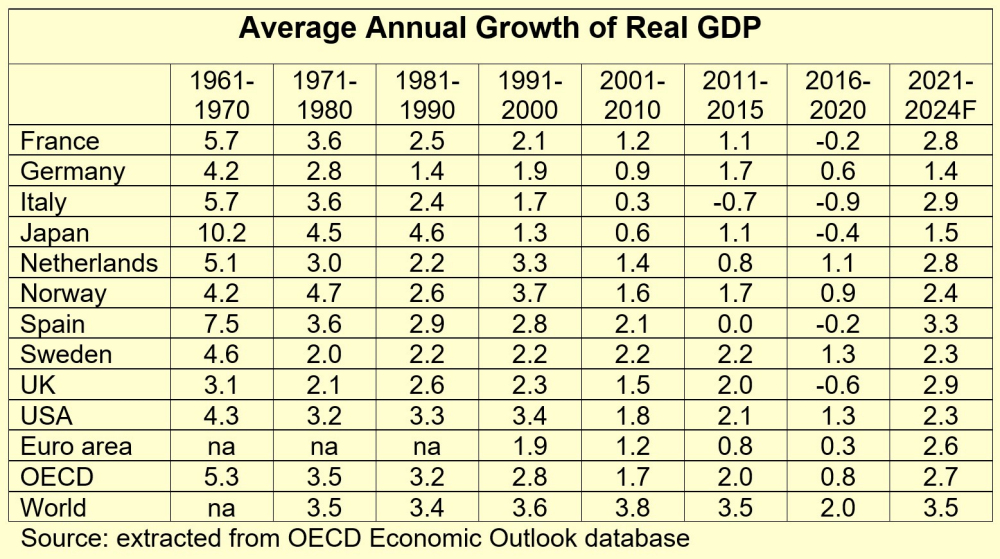
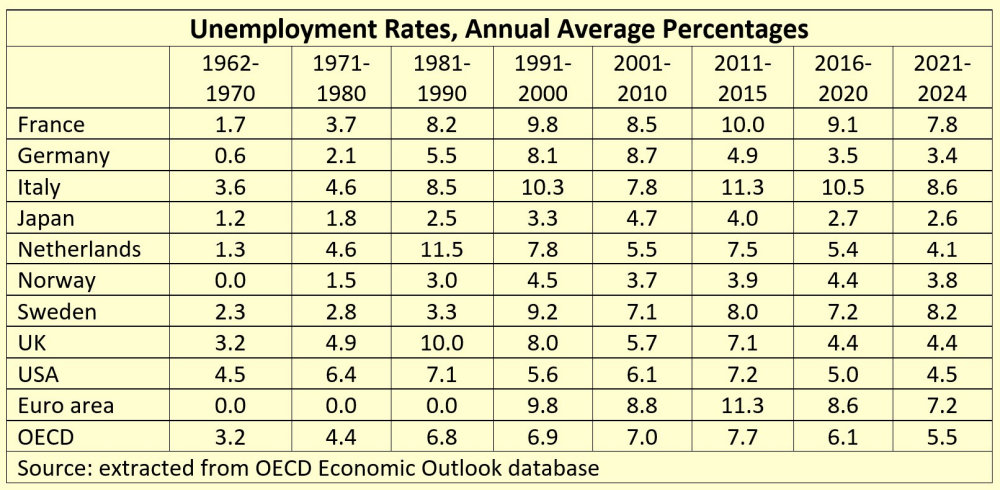
The relative decline seemed to be ending during the years
before the Brexit vote in 2016, but the UK has been a bit
shaky, compared to other OECD countries, since that
decision. Of course, the global market shares of the US,
UK, and other OECD countries is declining relative to China,
India, and other emerging economies).
II. Possible Reasons for
Relative Decline
A. Disadvantages of a head
start - After Industrial Revolution, Britain
saddled with an outdated capital stock.
B. Policy of laissez faire - In 19th C.,
U.S. and others protected key industries and pursued
industrial policies.
C. Military pending, empire, and slavery - This is a huge and complicated
subject. On one side of the ledger, British gains from control
over colonial land, slave trade, and slave ownership
represented a "massive redistribution of the world's resources
from native peoples to Britain."(Daunton)
According to research by Steve Redding at Princeton, about 1/3
of slaves to America were transported on British ships. slave
holding in the Americas contributed 3.5% per year to British
GDP until it was abolished in 1833 (and then the slaveholders,
rather than the slaves, were compensated in in England when
the practice ended). Emigration from England to the colonies
also prevented overpopulation in England. On the other hand,
maintaining the empire became expensive and unsustainable, and
its loss removed those gains. Still, the UK continued to
invest more in the military after WWII than other European
countries (habits die hard).
D. Stop-go fiscal policy
- Alternating unemployment and balance of payments crises.
Hansen found the British government was the only one that
destabilized the domestic economy.
E. High marginal tax
rates - Before Thatcher (in 1976), had 41% avg.
rate (32% in U.S. and 21% in Japan).
F. Sociological problems-
Entrepreneurial spirit dwindled with successive
generations. Labor productivity was stifled by the trade
union establishment. The educational system served upper
classes and de-emphasized natural science, engineering, and
business. Again, the UK has made great progress in those areas
in recent years.
III. The Labor Market and Labor Relations
-
A. Labor Unions
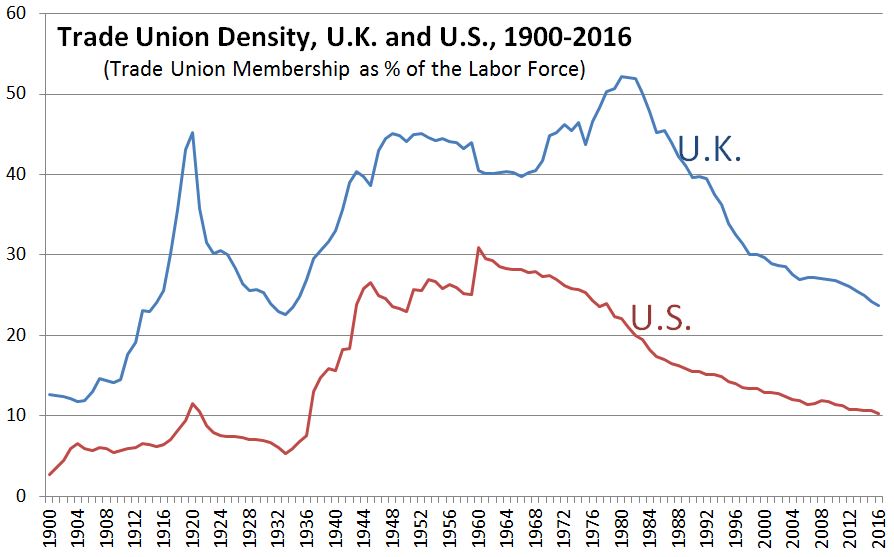
1. Cover about 24% of the labor force, down from a
peak of 52% in 1980. That's much larger than the 10% share in
the U.S. and much smaller than 65% in Sweden.
2. Traditionally, strong political role through
the Labor Party.
3. A strong democratic socialist tradition.
4. All major unions (48 of them) are members of
the Trades Union Congress, often compared to the AFL-CIO in
the U.S. (but the United Auto Workers and the Teamsters have
not always been members of the AFL-CIO)
B. Labor Legislation and Union
Growth -
1. Before 19th century,
Britain maintained strict regulations against union
activities.
2. After 1825,
the unions were given more rights and membership grew
rapidly. The inflation rate, unemployment rate, and
growth of money wages influenced union growth.
3. Thatcher
administration caused reduction in union
membership. Tight monetary policy decreased inflation
and increased unemployment; both discourage unionism.
New legislation required secret ballot elections to approve
closed shops or to approve union action, removal of legal
immunity of union leaders, and reelection of executive
committees every five years.
4. Trade Union Reform
and Employment Bill of 1993 gave workers more
freedom of choice in membership, tightened controls on
elections before strikes, abolished wage councils
(institutions that administered the minimum wage), and gave
women 14 weeks maternity leave and protection from dismissal.
5. Tony Blair, who became Labor PM in 1997,
praised Thatcher “modernization,” but supported return of the
minimum wage.
This was initially controversial, but now the minimum wage
system is supported by the Conservatives and all of the
major parties. Next
month (April 2023) the wage will be adjusted to £10.42
($12.78) for adults aged 25 and over, £10.18 ($12.49) for ages
21-24, £7.49 ($9.19) for ages 18-20, and £5.28 ($6.48) for
ages under 18 and apprentices, and these have been changed
every year. The U.S. federal minimum wage is $7.25 for covered
non-exempt employees, and has been unchanged since 2009
(although some
states, but not Texas and 21 other states, have set
minimum wages as high as $15.74/hour).
IV. Governmental Sector
A. Before World War II, government played small economic
role. During the war, Beveridge Committee recommended
welfare state. The Attlee government established
National Health Service and nationalized Bank of England,
steel, public utilities, and transport. Some programs
terminated by Thatcher, but some remain, such as the National
Health Service and allowances for children.
B. The Nationalized Industries
-
1. Reasons for
nationalization: ideology, national security,
maintain employment, regulate natural monopolies, provide for
external benefits in industries such as health care
2. Problems - Many
of the nationalized industries failed to turn a profit and
required subsidies. However, they were often
nationalized to pursue goals other than profit maximization.
3. Privatization - Beginning
with Thatcher, several industries sold to stockholders.
Some have become profitable. Raised revenue for budget
and created new group of stockholders. Intended to improve
efficiency, reduce costs, and strengthen competitiveness.
Weakened the position of trade unions, because industries were
removed from politics. Critics say that the government sold
the assets too cheaply, that profits are excessive, and that
firms should not be allowed to exercise monopoly power.
Started a revolution of privatizations all over the world.
C. Redistribution of Income and
Wealth - The British tax system is relatively
progressive, and social welfare programs have been accompanied
by a decline in inequality of income and wealth since World
War II. However, the distribution of income after taxes and
transfers is barely more equal than our in the U.S. and is far
more unequal than most of Western Europe..
D.
National
Health Service
- Created in 1948, the NHS is the oldest and largest
single-payer health care system in the world. Doctors paid on
capitation basis. Patient and doctor choice.
Recent reforms are designed to separate public funding from
public control; allow doctors to handle own budgets and
contract with hospitals. In a 2016
survey, the NHS was at the top of the list of "things
that make us proud to be British (50%), ahead of "our history"
(43%) and the Royal Family (31%).
V.
Brexit
- Road
to Brexit
1961 and 1969 The UK applies for EEC membership, but
vetoed by French President de Gaulle both times before his
death in 1970.
1973: UK joins EEC under
Conservative Prime Minister, Edward Heath.
1975: Just two years after
joining, Labour PM Harold Wilson held a referendum on the
question: “Do you think the UK should stay in the European
Community?” 67 percent voted “Yes,” but Labour Party split
over the issue, with the pro-Europe wing splitting from
the rest of the party to form the Social Democratic Party
(SDP).
1988:
Margaret Thatcher "Bruges
Speech": On one hand, "Britain does not dream of
some cosy, isolated existence on the fringes of the
European Community. Our destiny is in Europe, as part of
the Community."
On the other hand, "My first guiding principle is this:
willing and active cooperation between independent
sovereign states is the best way to build a successful
European Community... Europe will be stronger precisely
because it has France as France, Spain as Spain, Britain
as Britain, each with its own customs, traditions and
identity... Some of the founding fathers of the Community
thought that the United States of America might be its
model. But the whole history of America is quite different
from Europe."
2016: Fulfilling a promise to
members of his own party, Conservative PM David Cameron
negotiates new terms for UK/EU relationship (hoping this
would convince voters to vote for "stay"), but 51.9%
supported leaving the EU. Cameron stepped down and Theresa
May (who had also opposed Brexit) became PM.
2018 (November) PM May reaches an
agreement with EU on terms for Brexit, but quickly runs
into opposition in both Conservative and Labour parties.
Biggest issue was/is the "Northern
Ireland Backstop"
The Challenge
1. No hard border in Ireland
2. Agreement that avoids a hard
Brexit
3. Gaining independence from EU product quality and safety
standards.
Theresa May Deal
All of UK remained temporarily in EU customs union
Northern Ireland remained temporarily under EU product
standards.
But this was unacceptable to Brexiteers, and especially to
members of the Democratic
Unionist Party (DUP) of Northern Ireland.
-
2019 Boris Johnson became Prime
Minister in July, and started renegotiating the agreement.
Brexit officially happened on January 31, 2020, but it was
agreed that negotiations would continue during the
following year during the planned transition period. It
started looking like there might be a damaging no-deal
conclusion at the end of 2020, but a last-minute agreement
was reached on Christmas Eve that entered force in 2021.
Key provisions:
-
*
Goods moved without tariffs or quotas between
the UK and EU, but required new inspections and
paperwork, because the UK will not respect all of the
EU quality/safety requirements. Also, sales of
services became more complicated, because professional
qualifications are no longer mutually respected.
*
There was no hard border between Northern
Ireland and the Irish Republic, but, to avoid that,
Northern Ireland had to continue following many of the
EU rules, and new checks were introduced on goods
entering Northern Ireland from the rest of the UK. The
DUP and other unionist groups declared that Boris
Johnson had
betrayed them, raising the possibility
that the two parts of Ireland may be united in the
future.
*
Freedom to work and live between the UK and the EU
comes to an end, and UK nationals now need a visa to
stay in the EU more than 90 days in a 180-day period.
-
*
The UK would be free to negotiate its own trade
deals with the U.S. and other countries.
-
2022 (September) Boris
Johnson loses office, partly because of parties
during COVID lockdown, and was followed by Liz
Truss, who was immediately unsuccessful (served only
7 weeks) after submitting a "mini-budget" with large
borrowing and tax cuts, causing financial
instability.
2022 (November) Rishi
Sunak became prime minister. In February 2023, he
and Ursula
von der Leyen announced a "Windsor Framework." It
would:
-
*
Simplify the movement of goods crossing the
Irish Sea from Great Britain to Northern
Ireland. Goods being sent for final sale in
Northern Ireland would be subject to less
inspection and paperwork than goods destined for
the EU Common Market.
-
*
Some EU law would apply in Northern Ireland, but
Sunak said "the only EU law that applies in
Northern Ireland under the framework is the
minimum necessary to avoid a hard border with
Ireland and allow Northern Irish businesses to
continue accessing the EU market"
-
* The
Northern Ireland Assembly in Stormont can pull
an "emergency brake" if it disagrees with an EU
goods law which "would have significant, and
lasting effects on everyday lives."
- Yesterday
(3/22/2023), Parliament approved he Windsor
Framework by a vote of 515 votes to 29, but it was
opposed by the DUP that said the "Stormont
Brake" needs to be strengthened, and it was also
opposed by former prime ministers Boris Johnson and
Liz Truss who said it means "the whole of the UK"
will be unable "properly to diverge and take
advantage of Brexit".
Impact
of Brexit
Now that Brexit is happening, what is its significance? Time
will tell, and it's difficult to untangle the results of
Brexit from the results of COVID, but overall the results are
not as positive as promised or as disastrous as some
predicted. Here are some of the early indications:
1.
GDP growth was negative during 2016-2020 (while it was
positive in the Euro area), but it seems to be recovering and
unemployment has remained stable. But this is
underperformance compared to what was promised by the
Brexiteers.
2.
Trade in goods with the EU fell sharply after the
Brexit transition period ended, with UK imports from the EU
dropping by approximately 25 per cent more than UK imports
from the rest of the world, a trend which persisted throughout
2021.
3.
Potentially, trade in services may be a bigger problem
than trade in goods, because they are not covered by the
so-called "trade and co-operation agreement" (TCA), and they
represent the faster-growing part of British exports. The
impact on financial services was already noted above - 44% of
British financial services firms had moved or planned to move
operations and/or staff to the EU. According to The Economist,
"Musicians, actors, fashion designers and professional-service
firms are griping about expensive red tape and travel
restrictions."
A 2022 scandal involved P&O Ferries, a British company
that operates ferries from the UK to Ireland and the
European continent. P&O laid off 800 of its workers (and
removed some of them forcefully from the ships), telling them
that the ships would now be “primarily crewed by a third-party
crew provider.” Critics have charged that Brexit, which was
supposed to protect the UK from requirements to accept
European workers, has instead weakened enforcement of UK labor
laws, making it easier to replace British P&O workers with
“cheap agency workers from eastern Europe.”
4.
The UK has an opportunity to review its regulations,
and end some of those that were imposed by the EU. However,
The Economist predicts that divergence from EU
structures will be minimal, because (a) the trade deal that
was reached in December 2020 requires the UK to stay close to
European norms in order to stay in the free-trade area, (b)
"Britain shaped European law" and "EU rules have become de
facto global standards" in many sectors and (c)
divergence from EU norms in England while Northern Ireland is
forced to follow them would exacerbate the England/Ireland
divide. According to Philip Hammond, a former Conservative
chancellor, "Britain has paid a fantastically high price for
an autonomy it won’t use."
4. Financial sector - London has
been the world's most important center for international
lending, insurance, shipping contracts, and trading of gold
bullion, Eurocurrencies, and Eurobonds, and has the third
largest stock market. Bank of England independence was
granted by Labour (opposed by Tories) in 1997.
There was considerable concern that Brexit would damage the
UK's position as a financial center. According to our
assigned reading by Perri, "The financial sector will be the
most damaged in the case of Hard Brexit because it is easy
to leave for financial institutions, insurances, banks, and
multinationals that are operating in London (until now) to
take advantage of the low taxation rate." Between the 2016
Brexit vote and the end of 2021, EY
reported that 44% (97 out of 222) of British financial
services firms had moved or planned to move operations
and/or staff to the EU. Also, 24 financial services firms
declared they would transfer over £1.3trn of UK assets to
the EU and the Bank
of England reported that 7,500 jobs have been lost in
the financial sector and the fallout may continue for
several years.
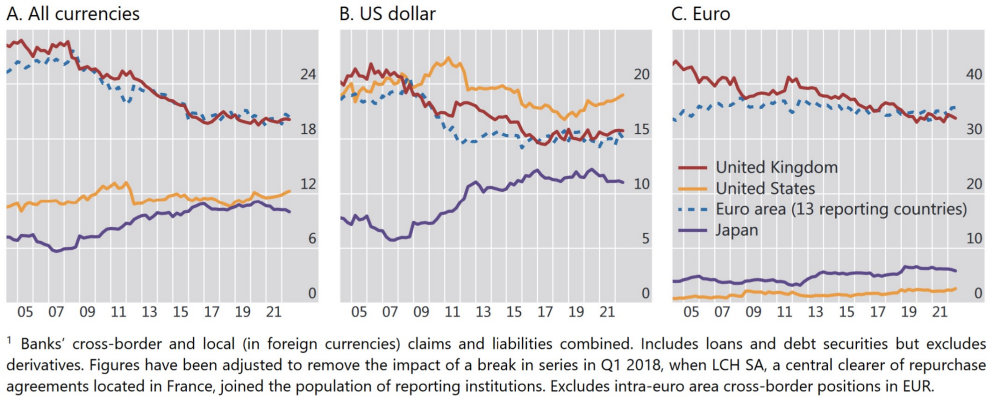
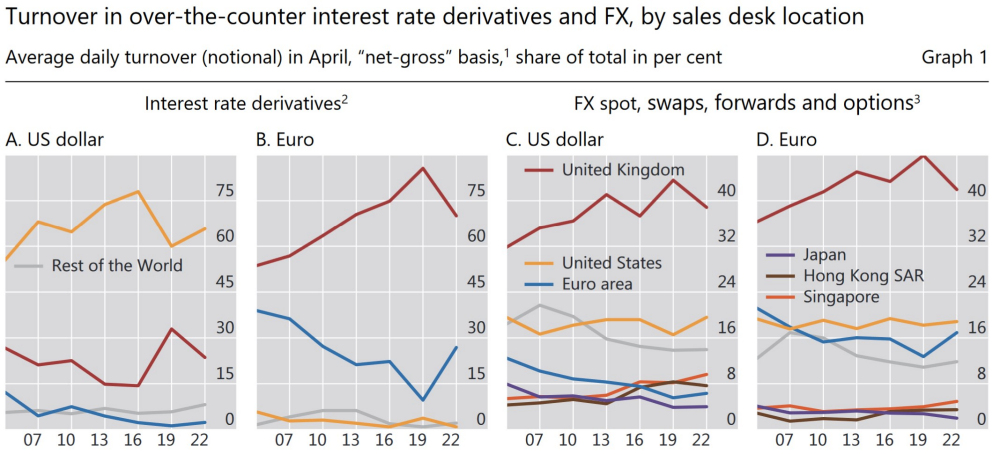
Despite all that, a December
2022 report by the Bank for International Settlements
(BIS) declares that "London has retained its
pre-eminence as an international financial center," and its
role has eroded only marginally. Here are a couple of charts
from that report:
5.
Public Opinion. In 2016, Brexit was adopted
with relatively weak support - 51.9%. That result was driven
largely by older voters, and especially by those in rural
areas. Surveys
indicate that 64% of voters over 65 voted to leave,
while the youngest category, 18- to 24-year olds, voted by 71%
to remain.
According to YouGov
polls in the UK, the percentage who believe it was a
mistake to leave has been steadily rising for about two years.
Now, 54% say it was wrong to leave, 33% say it was right, and
13% say they don't know. A large part of that shift is not a
change in individual opinions, but entry of younger people
into the pool. Among those born before 2004, 64% say that
Brexit was a mistake, but they were too young to vote in 2016.
|