Adam Smith Biography
1723 -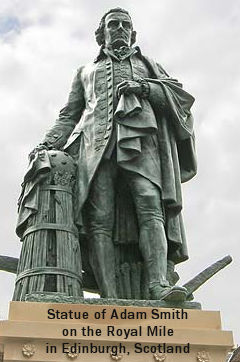 Born in Kirkaldy, Scotland
1737-1747 - Education in Glasgow and Oxford
1748 - Started teaching logic in Glasgow
1759 - Published Theory of Moral Sentiments
1764-1766 - Tutor for young duke, touring in France
1766-1776 - Wrote Wealth of Nations
1778 - Appointed
Commissioner of Customs in Edinburgh
1790 - Died in Edinburgh, buried in Canongate Kirkyard on the
Royal Mile
The Theory of Moral Sentiments
by Adam Smith 1759
Part III
Of the Foundation of our
Judgments concerning
our own Sentiments and Conduct, and of the Sense of Duty
III.I.46
Let us suppose that the great empire of China, with all its
myriads of inhabitants, was suddenly swallowed up by an
earthquake, and let us consider how a man of humanity in
Europe, who had no sort of connexion with that part of the
world, would be affected upon receiving intelligence of this
dreadful calamity. He would, I imagine, first of all, express
very strongly his sorrow for the misfortune of that unhappy
people, he would make many melancholy reflections upon the
precariousness of human life, and the vanity of all the
labours of man, which could thus be annihilated in a moment.
He would too, perhaps, if he was a man of speculation, enter
into many reasonings concerning the effects which this
disaster might produce upon the commerce of Europe, and the
trade and business of the world in general. And when all this
fine philosophy was over, when all these humane sentiments had
been once fairly expressed, he would pursue his business or
his pleasure, take his repose or his diversion, with the same
ease and tranquillity, as if no such accident had happened.
The most frivolous disaster which could befall himself would
occasion a more real disturbance. If he was to lose his little
finger to-morrow, he would not sleep to-night; but, provided
he never saw them, he will snore with the most profound
security over the ruin of a hundred millions of his brethren,
and the destruction of that immense multitude seems plainly an
object less interesting to him, than this paltry misfortune of
his own. To prevent, therefore, this paltry misfortune to
himself, would a man of humanity be willing to sacrifice the
lives of a hundred millions of his brethren, provided he had
never seen them? Human nature startles with horror at the
thought, and the world, in its greatest depravity and
corruption, never produced such a villain as could be capable
of entertaining it. But what makes this difference? When
our passive feelings are almost always so sordid and so
selfish, how comes it that our active principles should
often be so generous and so noble? When we are always so
much more deeply affected by whatever concerns ourselves,
than by whatever concerns other men; what is it which
prompts the generous, upon all occasions, and the mean
upon many, to sacrifice their own interests to the greater
interests of others? It is not the soft power
of humanity, it is not that feeble spark of benevolence which
Nature has lighted up in the human heart, that is thus capable
of counteracting the strongest impulses of self-love. It is a
stronger power, a more forcible motive, which exerts itself
upon such occasions. It is
reason, principle, conscience, the inhabitant of the
breast, the man within, the great judge and arbiter of our
conduct. It is he who, whenever we are about to
act so as to affect the happiness of others, calls to us, with
a voice capable of astonishing the most presumptuous of our
passions, that we are but one of the multitude, in no respect
better than any other in it; and that when we prefer ourselves
so shamefully and so blindly to others, we become the proper
objects of resentment, abhorrence, and execration. It is from
him only that we learn the real littleness of ourselves, and
of whatever relates to ourselves, and the natural
misrepresentations of self-love can be corrected only by the
eye of this impartial spectator. It is he who shows us the
propriety of generosity and the deformity of injustice; the
propriety of resigning the greatest interests of our own, for
the yet greater interests of others, and the deformity of
doing the smallest injury to another, in order to obtain the
greatest benefit to ourselves. It is not the love of our
neighbour, it is not the love of mankind, which upon many
occasions prompts us to the practice of those divine virtues.
It is a stronger love, a more powerful affection, which
generally takes place upon such occasions; the love of what is
honourable and noble, of the grandeur, and dignity, and
superiority of our own characters.
III.I.47
When the happiness or misery of others depends in any respect
upon our conduct, we dare not, as self-love might suggest to
us, prefer the interest of one to that of many. The
man within immediately calls to us, that we value
ourselves too much and other people too little, and that, by
doing so, we render ourselves the proper object of the
contempt and indignation of our brethren. Neither is this
sentiment confined to men of extraordinary magnanimity and
virtue. It is deeply impressed upon every tolerably good
soldier, who feels that he would become the scorn of his
companions, if he could be supposed capable of shrinking from
danger, or of hesitating, either to expose or to throw away
his life, when the good of the service required it.
NOTE:
Smith's "man within" who follows a rule of "reason" is
similar, in some respects to the Categorical Imperative in the
writing of his German contemporary, Immanuel Kant
(1724-1804). Kant argued that there are unconditional moral
laws that are so fundamental that they would be followed by
any rational person, regardless of any personal motive or
desire. It also pointed forward to the ethical system
suggested by the American political philosopher, John Rawls
(1921-2002), with hypothetical judgments made in the "initial
position" behind a "veil of ignorance."
Book 1, Chapter 1
An Inquiry into the Nature and
Causes of the Wealth of
Nations
by Adam Smith 1776
INTRODUCTION AND PLAN OF THE WORK
[I, intro, 1,
p. 10]
The annual
labour of every nation is the fund which originally supplies
it with all the necessaries and conveniences of life which it
annually consumes, and which consist always either in the
immediate produce of that labour, or in what is purchased with
that produce from other nations.
According therefore as this produce, or what is purchased with
it, bears a greater or smaller proportion to the number of
those who are to consume it, the nation will be better or
worse supplied with all the necessaries and conveniences for
which it has occasion.
But this proportion must in every nation be regulated by two
different circumstances; first, by the skill, dexterity, and
judgment with which its labour is generally applied; and,
secondly, by the proportion between the number of those who
are employed in useful labour, and that of those who are not
so employed. Whatever be the soil, climate, or extent of
territory of any particular nation, the abundance or
scantiness of its annual supply must, in that particular
situation, depend upon those two circumstances.
Book 1, Chapter 1
OF THE DIVISION OF LABOUR
[I, i, 1, p.
13]
THE greatest
improvement in the productive powers of labour, and the
greater part of the skill, dexterity, and judgment with which
it is anywhere directed, or applied, seem to have been the
effects of the division of labour. . .
[I, i, 3, p. 14]
To take an example, therefore, from a very trifling
manufacture; but one in which the division of labour has been
very often taken notice of, the trade of the pin-maker; a
workman not educated to this business ... could scarce,
perhaps, with his utmost industry, make one pin in a day, and
certainly could not make twenty. But in the way in which this
business is now carried on, ... it is divided into a number of
branches, of which the greater part are likewise peculiar
trades. One man draws out the wire, another straights it, a
third cuts it, a fourth points it, a fifth grinds it at the
top for receiving the head; … the important business of making
a pin is, in this manner, divided into about eighteen distinct
operations… I have seen a small manufactory of this kind where
ten men only were employed, and where some of them
consequently performed two or three distinct operations. But
though they were very poor, and therefore but indifferently
accommodated with the necessary machinery, they could, when
they exerted themselves, make among them about twelve pounds
of pins in a day. There are in a pound upwards of four
thousand pins of a middling size… Each person, therefore,
making a tenth part of forty-eight thousand pins, might be
considered as making four thousand eight hundred pins in a
day. But if they had all wrought separately and independently,
and without any of them having been educated to this peculiar
business, they certainly could not each of them have made
twenty, perhaps not one pin in a day…
[I, i, 5, p.
17]
This great increase of the quantity of work which, in
consequence of the division of labour, the same number of
people are capable of performing, is owing to three different
circumstances; first, to the increase of dexterity in every
particular workman; secondly, to the saving of the time which
is commonly lost in passing from one species of work to
another; and lastly, to the invention of a great number of
machines which facilitate and abridge labour, and enable one
man to do the work of many.
[I, i, 8, p. 19]
Thirdly, and lastly, everybody must be sensible how much
labour is facilitated and abridged by the application of
proper machinery. It is unnecessary to give any example. I
shall only observe, therefore, that the invention of all those
machines by which labour is so much facilitated and abridged
seems to have been originally owing to the division of labour.
Men are much more likely to discover easier and readier
methods of attaining any object when the whole attention of
their minds is directed towards that single object than when
it is dissipated among a great variety of things. . .
Book 1, Chapter 2
OF THE PRINCIPLE WHICH GIVES
OCCASION
TO THE DIVISION OF LABOUR
[I, ii, 1, p.
25]
THIS division
of labour, from which so many advantages are derived, is not
originally the effect of any human wisdom, which foresees and
intends that general opulence to which it gives occasion. It
is the necessary, though very slow and gradual consequence of
a certain propensity in human nature which has in view no such
extensive utility; the propensity to truck, barter, and
exchange one thing for another.
Whether this propensity be one of those original principles in
human nature of which no further account can be given; or
whether, as seems more probable, it be the necessary
consequence of the faculties of reason and speech, it belongs
not to our present subject to inquire. It is common to all
men, and to be found in no other race of animals, which seem
to know neither this nor any other species of contracts. Two
greyhounds, in running down the same hare, have sometimes the
appearance of acting in some sort of concert. Each turns her
towards his companion, or endeavours to intercept her when his
companion turns her towards himself. This, however, is not the
effect of any contract, but of the accidental concurrence of
their passions in the same object at that particular time.
Nobody ever saw a dog make a fair and deliberate exchange of
one bone for another with another dog… In civilised society [a
man] stands at all times in need of the cooperation and
assistance of great multitudes, while his whole life is scarce
sufficient to gain the friendship of a few persons. In almost
every other race of animals each individual, when it is grown
up to maturity, is entirely independent, and in its natural
state has occasion for the assistance of no other living
creature. But man has almost constant occasion for the help of
his brethren, and it is in vain for him to expect it from
their benevolence only. He will be more likely to prevail if
he can interest their self-love in his favour, and show them
that it is for their own advantage to do for him what he
requires of them… It is not from the benevolence of the
butcher, the brewer, or the baker that we expect our dinner,
but from their regard to their own interest. We address
ourselves, not to their humanity but to their self-love, and
never talk to them of our own necessities but of their
advantages. Nobody but a beggar chooses to depend chiefly upon
the benevolence of his fellow-citizens. . .
Book 1, Chapter 3
THAT THE DIVISION OF LABOUR IS
LIMITED BY THE EXTENT OF THE MARKET
[I, iii, 1,
p. 31]
AS it is the
power of exchanging that gives occasion to the division of
labour, so the extent of this division must always be limited
by the extent of that power, or, in other words, by the extent
of the market. When the market is very small, no person can
have any encouragement to dedicate himself entirely to one
employment, . . .
[I, iii, 3,
p. 32]
As by means of water-carriage a more extensive market is
opened to every sort of industry than what land-carriage alone
can afford it, so it is upon the sea-coast, and along the
banks of navigable rivers, that industry of every kind
naturally begins to subdivide and improve itself, and it is
frequently not till a long time after that those improvements
extend themselves to the inland parts of the country. . .
[I, iii, 4,
p. 34]
Since such, therefore, are the advantages of water-carriage,
it is natural that the first improvements of art and industry
should be made where this conveniency opens the whole world
for a market to the produce of every sort of labour, and that
they should always be much later in extending themselves into
the inland parts of the country. . .
[I, iii, 5,
p. 34]
The nations that, according to the best authenticated history,
appear to have been first civilised, were those that dwelt
round the coast of the Mediterranean Sea. That sea, by far the
greatest inlet that is known in the world, having no tides,
nor consequently any waves except such as are caused by the
wind only, was, by the smoothness of its surface, as well as
by the multitude of its islands, and the proximity of its
neighbouring shores, extremely favourable to the infant
navigation of the world . . .
Book 1, Chapter 4
OF THE ORIGIN AND USE OF MONEY
[I, iv, 11,
p. 44]
It is in this manner that money has become in all civilised
nations the universal instrument of commerce, by the
intervention of which goods of all kinds are bought and sold,
or exchanged for one another.
What are the rules which men naturally observe in exchanging
them either for money or for one another, I shall now proceed
to examine. These rules determine what may be called the
relative or exchangeable value of goods.
The word value, it is to be observed, has two different
meanings, and sometimes expresses the utility of some
particular object, and sometimes the power of purchasing other
goods which the possession of that object conveys. The one may
be called "value in use"; the other, "value in exchange." The
things which have the greatest value in use have frequently
little or no value in exchange; and, on the contrary, those
which have the greatest value in exchange have frequently
little or no value in use. Nothing is more useful than water:
but it will purchase scarce anything; scarce anything can be
had in exchange for it. A diamond, on the contrary, has scarce
any value in use; but a very great quantity of other goods may
frequently be had in exchange for it.
In order to investigate the principles which regulate the
exchangeable value of commodities, I shall endeavour to show:
First, what is the real measure of this exchangeable value;
or, wherein consists the real price of all commodities.
Secondly, what are the different parts of which this real
price is composed or made up.
And, lastly, what are the different circumstances which
sometimes raise some or all of these different parts of price
above, and sometimes sink them below their natural or ordinary
rate; or, what are the causes which sometimes hinder the
market price, that is, the actual price of commodities, from
coinciding exactly with what may be called their natural
price.
Book 1, Chapter 5
OF THE REAL AND NOMINAL PRICE OF
COMMODITIES, OR THEIR PRICE IN
LABOUR,
AND THEIR PRICE IN MONEY
[I, v, 1, p.
47]
EVERY man is
rich or poor according to the degree in which he can afford to
enjoy the necessaries, conveniences, and amusements of human
life. But after the division of labour has once thoroughly
taken place, it is but a very small part of these with which a
man's own labour can supply him. The far greater part of them
he must derive from the labour of other people, and he must be
rich or poor according to the quantity of that labour which he
can command, or which he can afford to purchase. The value of
any commodity, therefore, to the person who possesses it, and
who means not to use or consume it himself, but to exchange it
for other commodities, is equal to the quantity of labour
which it enables him to purchase or command. Labour,
therefore, is the real measure of the exchangeable value of
all commodities.
The real price of everything, what everything really costs to
the man who wants to acquire it, is the toil and trouble of
acquiring it. What everything is really worth to the man who
has acquired it, and who wants to dispose of it or exchange it
for something else, is the toil and trouble which it can save
to himself, and which it can impose upon other people. What is
bought with money or with goods is purchased by labour as much
as what we acquire by the toil of our own body. . .
[I, v, 4, p. 48]
But though labour be the real measure of the exchangeable
value of all commodities, it is not that by which their value
is commonly estimated. . .
[I, v, 6, p.
49]
But when barter ceases, and money has become the common
instrument of commerce, every particular commodity is more
frequently exchanged for money than for any other commodity. .
. Hence it comes to pass that the exchangeable value of every
commodity is more frequently estimated by the quantity of
money, than by the quantity either of labour or of any other
commodity which can be had in exchange for it.
Gold and silver, however, like every other commodity, vary in
their value, are sometimes cheaper and sometimes dearer,
sometimes of easier and sometimes of more difficult purchase.
. . Equal quantities of labour, at all times and places, may
be said to be of equal value to the labourer. In his ordinary
state of health, strength and spirits; in the ordinary degree
of his skill and dexterity, he must always lay down the same
portion of his ease, his liberty, and his happiness. . .
Labour alone, therefore, never varying in its own value, is
alone the ultimate and real standard by which the value of all
commodities can at all times and places be estimated and
compared. It is their real price; money is their nominal price
only.
[I, v, 15, p. 53]
Equal quantities of labour will at distant times be purchased
more nearly with equal quantities of corn, the subsistence of
the labourer, than with equal quantities of gold and silver,
or perhaps of any other commodity. Equal quantities of corn,
therefore, will, at distant times, be more nearly of the same
real value, or enable the possessor to purchase or command
more nearly the same quantity of the labour of other people.
[I, v, 17, p.
54]
Labour, therefore, it appears evidently, is the only
universal, as well as the only accurate measure of value, or
the only standard by which we can compare the values of
different commodities at all times, and at all places. We
cannot estimate, it is allowed, the real value of different
commodities from century to century by the quantities of
silver which were given for them. We cannot estimate it from
year to year by the quantities of corn. By the quantities of
labour we can, with the greatest accuracy, estimate it both
from century to century and from year to year. From century to
century, corn is a better measure than silver, because, from
century to century, equal quantities of corn will command the
same quantity of labour more nearly than equal quantities of
silver. From year to year, on the contrary, silver is a better
measure than corn, because equal quantities of it will more
nearly command the same quantity of labour.
Working Time Required for a Worker
in the Basic Metals
Industry to Purchase Various
Consumer Items, 1999
(in
hours and minutes; so 22:43 represents 22 hours and 43 minutes)
|
|
Germany
|
Ghana
|
Japan
|
Mexico
|
Philippines
|
Russia
|
Sweden
|
U.S.
|
|
Food (1 kilo)
|
|
|
|
|
|
|
|
|
|
Bread
|
0:07
|
0:58
|
0:11
|
0:03
|
0:36
|
0:18
|
0:07
|
0:07
|
|
Beef
|
0:32
|
7:16
|
1:40
|
3:52
|
6:15
|
1:17
|
0:58
|
0:34
|
|
Rice
|
0:12
|
2:19
|
0:10
|
0:34
|
0:48
|
0:32
|
0:06
|
0:04
|
|
Oranges
|
0:05
|
1:10
|
0:11
|
0:12
|
1:52
|
0:41
|
0:05
|
0:05
|
|
Clothing
|
|
|
|
|
|
|
|
|
|
Men's
suit
|
10:55
|
232:11
|
22:43
|
80:20
|
34:10
|
34:10
|
16:06
|
11:17
|
|
Men's
shoes
|
4:47
|
77:24
|
5:41
|
20:06
|
17:50
|
13:31
|
4:50
|
3:23
|
|
Wom:
dress
|
9:30
|
135:26
|
16:23
|
24:08
|
12:38
|
12:42
|
8:03
|
4:31
|
|
Rent
|
|
|
|
|
|
|
|
|
|
3
rooms
|
18:04
|
338:35
|
46:15
|
160:50
|
200:30
|
8:24
|
36:14
|
19:45
|
|
Durables
|
|
|
|
|
|
|
|
|
|
Refrigerator
|
18:43
|
1,451:04
|
35:39
|
n.a.
|
490:06
|
187:25
|
40:15
|
14:06
|
|
Television
|
36:48
|
967:23
|
14:13
|
184:58
|
638:37
|
151:40
|
28:11
|
11:17
|
|
Midsize
car
|
916:54
|
40,630:12
|
855:48
|
9,649:52
|
14,851:20
|
4,884:05
|
1,207:31
|
1,015:09
|
Source:
International Metalworkers’ Federation, "International
Comparison of Average Net Hourly Earnings in 1999'"
http://www:imfmetal.org/imf/main/pub_files/POWER2000_English.pdf
National Price Levels Compared to
International Prices, 1996
(OECD
Prices = 100)
|
|
France
|
Germany
|
Italy
|
Japan
|
Norway
|
Sweden
|
UK
|
US
|
|
Food & beverages
|
114
|
109
|
106
|
187
|
166
|
139
|
105
|
80
|
|
Clothing & footwear
|
145
|
134
|
113
|
150
|
132
|
137
|
97
|
73
|
|
Rent & Utilities
|
129
|
141
|
70
|
174
|
106
|
135
|
80
|
90
|
|
Household equipment
|
116
|
116
|
105
|
184
|
120
|
128
|
89
|
82
|
|
Health care
|
93
|
111
|
79
|
87
|
121
|
136
|
73
|
115
|
|
Transport & communication
|
126
|
124
|
104
|
117
|
158
|
143
|
113
|
86
|
|
Education and recreation
|
126
|
112
|
109
|
135
|
142
|
142
|
92
|
88
|
Michelle A. Vachris and James Thomas,
“International Price Comparisons Based on Purchasing Power
Parity,” Monthly Labor Review, October 1999, p. 10
http://stats.bls.gov/opub/mlr/1999/10/art1full.pdf
National Price Levels Compared to
U.S. Prices, 1975
(U.S.
Prices = 100)
|
|
Low Income
|
Lower
Middle
|
Upper
Middle
|
High
Income
|
|
Food & beverages
|
51.3
|
62.9
|
71.7
|
109.9
|
|
Clothing & footwear
|
55.7
|
59.0
|
79.8
|
126.0
|
|
Rent & Utilities
|
47.8
|
56.4
|
47.6
|
103.1
|
|
Household equipment
|
45.5
|
60.8
|
84.3
|
99.2
|
|
Health care
|
27.5
|
29.7
|
35.9
|
62.0
|
|
Transport & communication
|
68.8
|
74.6
|
101.3
|
137.2
|
|
Education and recreation
|
19.1
|
29.1
|
46.9
|
102.7
|
Low Income = e.g.,
Malawi, India, Thailand
Lower Middle =
e.g., Korea, Colombia, Brazil
Upper Middle =
e.g., Romania, Mexico, Iran
High Income =
e.g., UK, Japan, Germany
Irving Kravis,
Alan Heston, and Robert Summers, World Product and
Income,
Johns Hopkins University Press, 1982
|